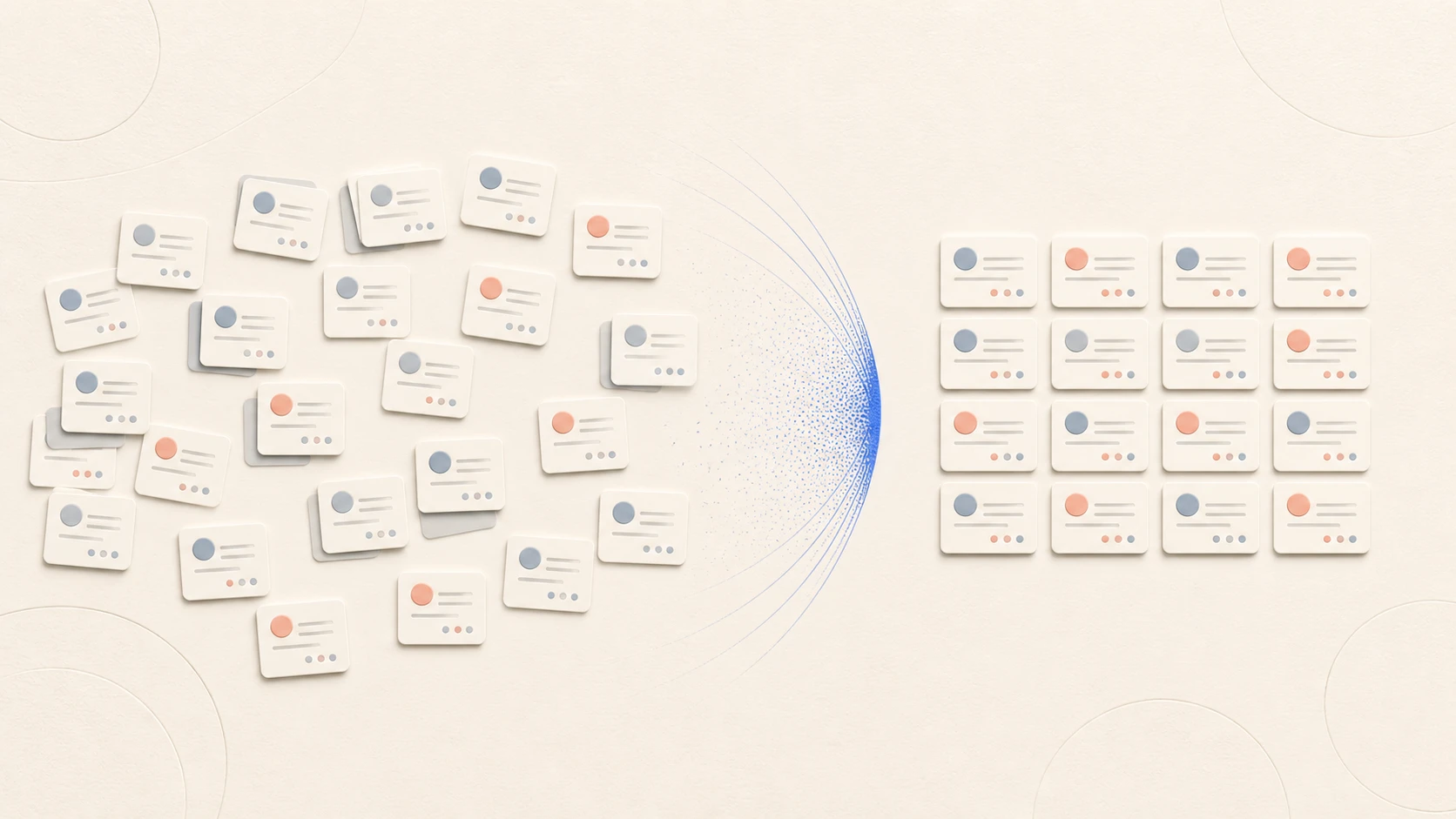
An AI agent can research hundreds of accounts before a sales team has agreed what a qualified account looks like. Speed is not the hard part. The hard part is retaining the evidence, uncertainty, ownership, and approval needed to explain why an account should move forward.
The verdict: use AI to prepare the decision, not to hide it
Leadbase is a strong fit when your bottleneck is turning a written ICP into a reviewable account shortlist: company context and qualification fields remain in a shared Sheet, focused research can retain sources and no-result states, and consequential actions can sit behind an approval step.
It is not a sequencer, dialer, CRM replacement, or guarantee that every company, person, or contact field can be found. If your primary requirement is autonomous campaign activation, native CRM administration, or maximum coverage from one contact-data vendor, choose the system built for that job first. Leadbase belongs before the handoff when the team needs to decide which accounts are worth contact research and outreach.
Leadbase publishes this article. The product statements below link to the corresponding Leadbase documentation, and the operating recommendations are deliberately separated from those product facts. If this controlled qualification step is the gap in your process, ask Leadbase to audit your ICP field contract and approval boundary.
What a trustworthy list-building workflow must prove
A persuasive summary is weak evidence. A reviewable workflow produces a chain that another person can inspect:
This order matters. A large candidate set is not proof of quality. A reachable email is not proof of buyer fit. A confident AI answer is not proof that its source establishes the criterion. Each layer should make the next commercial decision safer without pretending to eliminate judgment.
Define the commercial decision before the search
Most ICP descriptions combine facts, assumptions, and aspirations in one paragraph. An agent cannot reliably tell them apart. Before opening a database, write down the decision the list must support.
For one segment, answer five questions:
- Which problem must the account plausibly have? Name the operating condition your offer addresses, not just an industry label.
- What makes the account relevant now? This may be a visible initiative, hiring pattern, technology change, expansion, or another observable event. If timing does not matter, say so.
- Which role owns or feels the problem? Separate the likely business owner from an influencer, user, or procurement contact.
- What disqualifies an account? Geography, business model, company structure, incompatible technology, or an existing commercial relationship may be grounds for exclusion.
- What evidence is acceptable? Specify whether a company website, job posting, public registry, press release, or another source can support the decision.
The result should be testable. “European manufacturers that need automation” is not. “Manufacturing companies with operations in Germany, a visible maintenance or production leadership function, and current evidence of a plant-modernization initiative” is. The second version still needs research, but a reviewer can explain why a record passed or failed.
Turn the ICP into a field contract
A field contract defines what the research may write, what evidence it must retain, and what happens when the answer is unclear. It prevents a confident paragraph from masquerading as structured data.
Keep observations and decisions in separate columns. “The careers page lists three maintenance roles” is an observation. “This account has urgent buying intent” is an inference the source does not establish. Store the prior value when existing data changes so a reviewer can see whether the workflow found new evidence, corrected a field, or merely reformatted it.
The contract also assigns ownership. Sales operations can own identity and routing rules, a segment owner can approve qualification criteria, and an account owner can make the final activation decision. “The AI decided” is not an accountable workflow.
Build the list in six controlled stages
Consider an illustrative campaign for a software company selling maintenance planning to industrial businesses. The team wants German operating companies with a relevant production footprint and a plausible maintenance owner. This is an example of workflow design, not a claim about a real campaign.
1. Discover accounts broadly
Start at company level. Search from the written market description and collect enough context to distinguish an operating company from a holding company, reseller, consultancy, or unrelated business with similar keywords.
Do not request every email or phone number yet. Contact data has little value when the account itself has not passed qualification, and early lookup makes weak candidates unnecessarily expensive to discard.
2. Apply deterministic exclusions
Use ordinary filters for criteria that do not require interpretation: excluded countries, known customers, unsupported company types, or records already owned by another team. Deterministic rules are easier to audit and rerun than research.
Keep the reason for exclusion in a field. Otherwise, the same account may reappear in the next search and consume work again.
3. Research one criterion per field
Investigate narrow questions separately:
- Does the company operate a production site in the target geography?
- Is there current evidence of a maintenance, production, or plant-management function?
- Is there a public initiative that supports the timing hypothesis?
Each result should contain a status, short factual explanation, source, and check date. Avoid one large “research notes” field. When identity, fit, timing, and role are mixed in a paragraph, neither reviewers nor downstream rules can use the result consistently.
4. Calculate a decision state
Translate the completed fields into pass, review, or fail. Reserve pass for records that meet every required criterion. Use review for contradictory sources, ambiguous company structures, or missing evidence that a person can reasonably resolve. Failed records should retain the failed criterion and remain blocked from activation.
A numeric score may sort a queue, but it must not erase hard exclusions. An account with a high total score and one decisive disqualifier is still a failed account.
5. Resolve people and contact fields after qualification
Only now identify relevant people and request the fields needed for the planned channel. Keep role fit separate from contact availability: a reachable address does not make someone the right buyer, and a relevant buyer without a usable contact field should remain incomplete rather than receive guessed data.
The campaign still needs its own privacy and outreach review. Public availability, a business context, and technical reachability do not by themselves make a particular message or channel lawful or appropriate.
6. Activate only accepted records
Make the final transition explicit: an owner accepts the record, chooses the destination, and records the next action. Sending every discovered account directly into a CRM or sequence hides the moment when research became sales activity.
If the CRM is the system of record, define which fields this workflow may hand off and which rep-owned fields it must preserve. A list-building process should not overwrite account notes, lifecycle status, or active-opportunity context.
Configure Leadbase around review, not autonomy
The following setup maps that operating model to documented Leadbase surfaces:
- Start with a market description, then inspect the candidates. The Lead Database workflow is designed to narrow and review company and people context before contact lookup. It does not promise that every market or contact will be available.
- Keep the qualification contract in the Sheet. A Leadbase Sheet contains typed columns, rows, sharing rules, revision history, and optional AI-assisted enrichment. It is the durable workspace, not a disposable chat response. See Sheets and data.
- Give the Assistant a bounded job. Attach the active Sheet, name the rows and output, and ask for one concrete result. An attachment supplies context; it does not expand access or prove the attached claims. See Assistant basics.
- Review consequential actions. For unfamiliar work or broad research, “Ask for approval” exposes the target Sheet, rows, columns, intended operation, and any stated cost or external research step before it runs. Approval cannot bypass roles or access boundaries, and Assistant output remains a draft to inspect. See Approvals and safe Assistant actions.
- Use focused enrichment fields. Configure one target column from selected Sheet context, run it on selected rows, and inspect confidence, summary, and source links. Incomplete inputs or weak evidence may yield no usable result; that is a valid outcome. See Enrich data in a Sheet.
- Preserve review and handoff. Give collaborators the least Sheet access they need, review source links and personal data before sharing, and name important revisions such as an approved outreach list. See Sharing a Sheet and History and recovery.
MCP is optional, not a shortcut around governance. A supported AI client operates through the signed-in Leadbase session and only within the authorization Leadbase verifies for that session. That makes MCP useful when the list task begins in another AI client, but it does not create new data access or turn Leadbase into an autonomous sequencer. See Connect AI clients with MCP.
Chat history can help reopen the reasoning around a task, but the approved state belongs in the Sheet. Deleting a chat does not delete an attached Sheet, and a new conversation needs the current Sheet attached again. See Manage chat history.
Write instructions that produce reviewable output
The instruction should mirror the field contract. A compact specification is more useful than a persuasive persona prompt:
Test the instruction on edge cases before scaling it: a parent company with several subsidiaries, a manufacturer with only a sales office in the target market, a stale leadership page, and a company whose relevant role exists but is vacant. These cases expose ambiguity faster than a batch of obvious matches.
Put a measurable review gate before volume
Freeze a labelled sample before expanding the workflow. Include clear matches, clear failures, and borderline cases; a sample containing only top-ranked accounts does not test the difficult decisions.
For every correction, record the reason. Useful error categories include wrong company identity, an inferred criterion without evidence, a stale or irrelevant source, a role attached to the wrong entity, overlooked evidence, a missing required field, and an ignored hard exclusion.
Measure the workflow at field and decision level:
- Evidence coverage: records with acceptable evidence for every required criterion divided by records reviewed
- Decision agreement: records where the reviewer accepts the pass/review/fail state divided by records reviewed
- Correction rate by field: corrected values divided by reviewed values for that field
- Review rate: records routed to a person divided by records researched
- No-result rate: records where requested evidence or a contact could not be found divided by records processed
- Activation acceptance: records approved for the intended campaign divided by records submitted for final review
Do not collapse these into one vanity score. A high review rate can mean the instruction is too cautious, or it can be the correct response to weak public evidence. Inspect examples before moving a threshold. Replies and opportunities can help evaluate the segment and message later, but they do not prove that every underlying field was correct.
Choose the system for the actual bottleneck
This is the commercial boundary that makes Leadbase useful: it helps a team make and preserve the account decision before activation. It should complement the system of record and engagement tools, not be sold as all three.
Run a pilot that can fail honestly
Do not start a sales conversation with “How many leads can AI generate?” Start with one segment and an acceptance test. Bring the written ICP, known exclusions, 25 to 50 deliberately mixed accounts, the fields that determine acceptance, permitted source types, and one intended handoff destination.
Before the run, agree on the maximum correction rate for decisive fields, the required evidence coverage, who resolves review cases, and what would make the workflow unsuitable. After the review, compare accepted accounts—not raw row count—with the current method. If the evidence is too weak, the review burden too high, or the handoff does not fit the team, the pilot should say so.
Define the scorecard for a controlled Leadbase list-building pilot. The decision is not whether an agent can produce rows. It is whether your team can inspect, challenge, approve, and hand off the resulting list with its reasoning intact.
For the narrower operator job of turning one ICP brief into a reviewed account list, use the ICP-to-account implementation Guide and its downloadable translation record. This article remains the canonical discussion of agent instructions, evidence review, and safe pilot governance.